
Assessing the performance of Basralocus installed in the Bournemouth groyne field
Minor project 2025-2026 · Dr John Williams of RSK, commissioned by BCP Council / South West Flood and Coastal. £5,000 SCOPAC contribution.
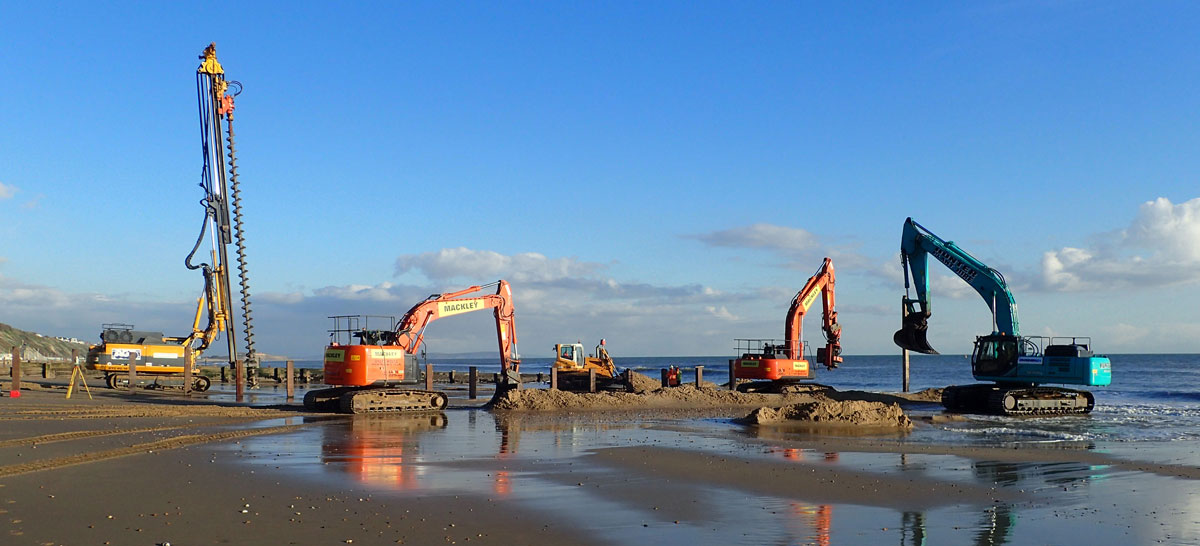
Timber groyne replacement, Bournemouth, winter 2015/16
Background
The principal factor preventing the widespread use of basralocus (Dicorynia guianensis) is the inability of suppliers to demonstrate that basralocus can meet the requirements of achieving a high Strength Class (D class) in accordance with BS EN 338[1].
However, in 2015, limited volumes of basralocus were used to construct one groyne (C36) in order to maintain the construction timetable. Consequently, there has been an isolated case where the needs of the construction timetable outweighed the requirement to use a timber species that was identified in BS EN 1912[2] as meeting the requirements for a specific Strength Class. However, in mitigation, basralocus was selected having undertaken due diligence on its performance in terms of its resistance to abrasion and marine borer attack with strength being the unknown factor. Basralocus had previously been included in BS EN 1912: 2012 as a timber that met the requirements for Strength Class D50 and this was for basralocus originating from French Guiana. However, it is no longer classified as D50 and has been downgraded to D24.
An assessment undertaken in January 2018 of the basralocous groyne at Bournemouth indicated that there was no evidence to indicate that the timber has been attacked by marine boring animals or that there was evidence indicating distress the basralocus groyne. However, further monitoring was recommended to evaluate the performance of basralocus over the short to medium term i.e. confirming there was no evidence to indicate that basralocus may be susceptible to premature systemic failure in service. This work was not commissioned.
Research Aims
The long-term performance of basralocus is unknown although there are basralocus groynes that will have been in service for ten years in Spring 2025 at Bournemouth, Poole Bay. This research therefore aims to assess the performance of the basralocus over the last 10 years, to make predictions on likely long term service life, and to offer pragmatic advice, based on experience, to support the use of a lesser used timber species, downgraded in BS EN 1912.
Conclusions from the report
- There was no evidence of structural failure of the basralocus piles on groyne C36. Therefore the assumption that basralocus met the requirements for Strength Class D50 was reasonable.
- The performance of basralocus after 10 years’ exposure on groyne C36 was variable.
- Severe gribble attack was observed on a number of planks in the sheltered parts of the downdrift face of the groyne.
- Severe gribble attack was observed on pile 9.
- 12% section loss was recorded on pile 5 due to a combination of erosion and gribble attack. Section loss on other piles ranged from 3% to 5%.
- The erosion rates on the basralocus were double those recorded on comparable greenheart piles.
- Overall, the inconsistent performance of basralocus in terms of its resistance to attack by the marine borer gribble makes it an unsuitable choice for Poole Bay.
- It is unlikely that the piles at the seaward end of groyne C36 will deliver 15 years’ service life, let alone the pile design life of 25 years.
- It is advisable to replace the seaward end of the groyne back to pile 10, and to replace with a combination of greenheart piles and ekki planking for maximum performance.
Timber Groynes - Evaluation of basralocus after 10 years in service
RSK for BCP Council / South West Flood and Coastal, November 2025
Download the report (PDF 6Mb)
SCG and SCOPAC research webinar
Alan Frampton and Dr John Williams presented their project findings in a webinar hosted by SCG and SCOPAC in June 2026, available at Basralocus assessment. The webinar recording is restricted by password to attendees and members.